
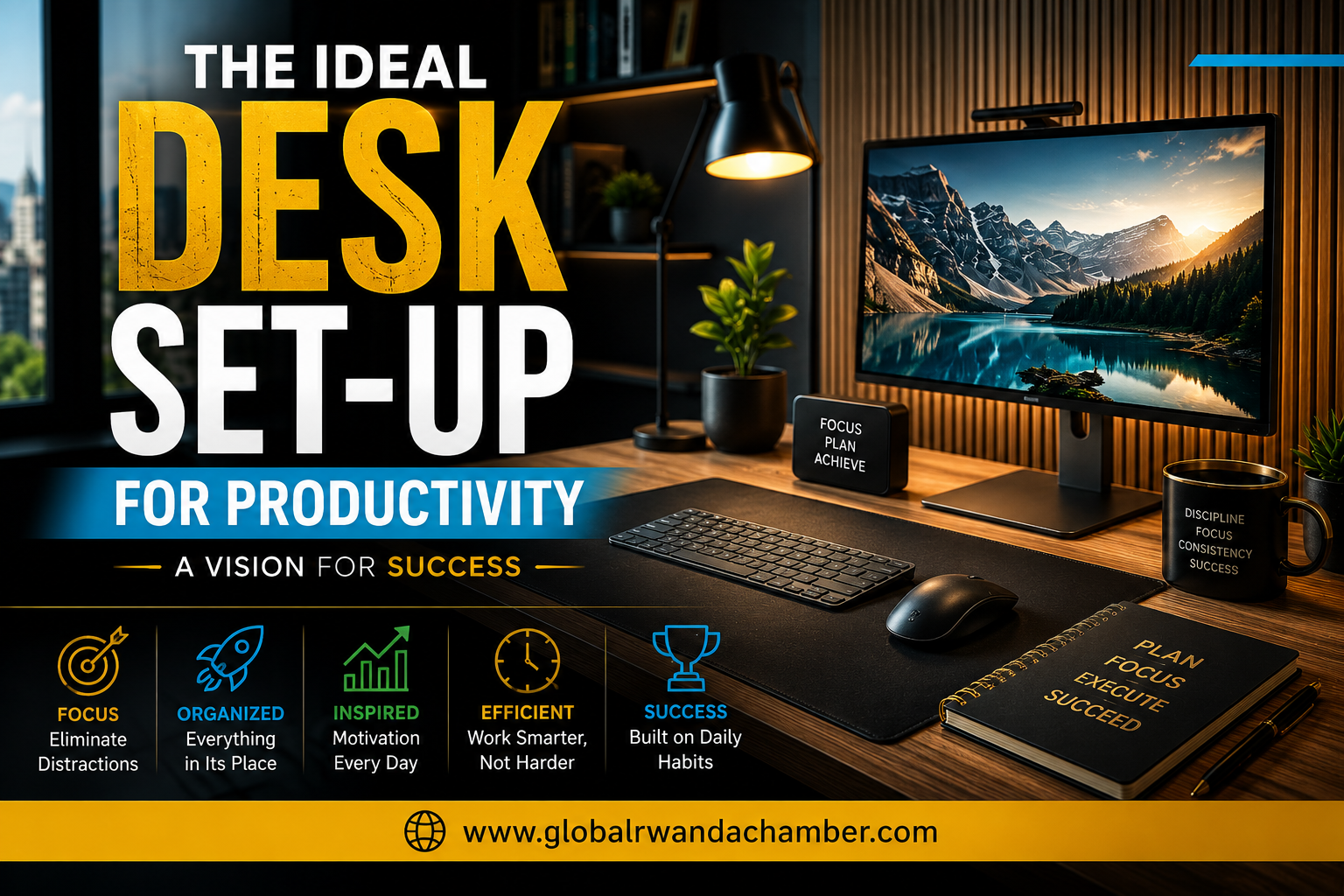
Your desk is not just a surface. It is a decision-making environment. It quietly shapes your focus, your energy, your discipline, and ultimately your output. Most people underestimate this truth and then wonder why they struggle with consistency, motivation, and deep work.
The difference between high performers and constantly distracted individuals is not always talent or time. It is environment design. A poorly structured desk setup doesn’t just slow you down; it fragments your attention, increases mental fatigue, and keeps you locked in reactive mode instead of intentional execution.
In today’s fast-moving digital world, where distractions are engineered into every device and notification, your desk must become a controlled space of clarity. If your workspace is chaotic, your thinking will mirror that chaos. If your setup is intentional, your output becomes sharper, faster, and more focused.
This is not about luxury. It is about engineering productivity.
Why Your Desk Setup Is Quietly Controlling Your Productivity
Every object on your desk sends a signal to your brain. Clutter signals unfinished tasks. Poor lighting signals fatigue. A disorganized layout signals lack of control. Over time, your mind absorbs these signals and begins operating in scattered patterns.
A powerful desk setup removes friction. It reduces the time between thought and action. It creates a mental “flow zone” where you can enter deep focus without resistance.
When your workspace is optimized, you stop wasting energy on deciding where things are, what to do next, or how to begin. Instead, your brain shifts into execution mode faster.
The Foundation of a High-Performance Desk Setup
A productive desk is built on three non-negotiable pillars:
1. Clarity of Space
Your desk should have visual breathing room. Minimalism is not aesthetic preference here; it is cognitive strategy. A clean surface reduces decision fatigue and keeps attention anchored on one task at a time.
2. Ergonomic Alignment
Your chair height, monitor level, keyboard position, and lighting must support your body, not fight it. Physical discomfort is one of the most underestimated productivity killers. Even slight misalignment leads to fatigue, which quietly reduces performance over long hours.
3. Intentional Tool Placement
Everything you use frequently should be within natural reach. Anything that interrupts focus should be removed or stored away. Your tools should support your workflow, not interrupt it.
The Psychology Behind a Productive Workspace
A well-designed desk setup does something powerful: it creates behavioral cues. When you sit down, your brain recognizes the environment as a “work zone,” reducing resistance to starting tasks.
This is how habits are built. Not through motivation, but through environment triggers.
If your desk is associated with focus, your mind will enter focus faster. If it is associated with distraction, your productivity will always feel like a battle.
This is why successful individuals obsess over their workspace design. They are not decorating; they are conditioning behavior.
What Most People Get Wrong About Desk Setups
Many people focus only on appearance. They buy expensive gadgets, aesthetic accessories, or trendy setups, but ignore functionality.
A productive desk is not about looking impressive on social media. It is about reducing friction in real work conditions.
Common mistakes include:
- Too many items on the desk
- Poor cable management causing visual noise
- Incorrect monitor height leading to neck strain
- Inadequate lighting reducing alertness
- Mixing personal entertainment and work zones in the same space
Each of these may seem minor individually, but together they create constant micro-distractions that drain mental energy.
Building a Desk That Forces Focus
If you want a workspace that actually increases output, design it with one question in mind: “Does this help me focus or pull me away from focus?”
Start with removal. Remove anything that does not directly support your work goals. Then rebuild with intention.
Position your primary screen at eye level to avoid physical strain. Ensure your chair supports long working hours without discomfort. Use lighting that reduces eye fatigue while keeping you alert.
Keep only the essentials visible. Everything else should have a designated place outside your immediate visual field.
The goal is simple: when you sit down, your brain should have no reason to hesitate.
The Urgency of Fixing Your Workspace Now
Every day spent working in a poorly designed environment compounds inefficiency. You are not just losing time; you are losing cognitive clarity and creative momentum.
Most people wait until burnout forces change. High performers design their environment before problems appear.
If your productivity feels inconsistent, if your focus breaks too easily, or if tasks feel heavier than they should, your workspace is often the hidden cause.
Fixing your desk setup is one of the fastest ways to reset your productivity without changing your job, schedule, or workload.
Conclusion: Your Desk Is Your Daily Operating System
Your workspace is not background scenery. It is the control center of your daily performance. Treating it casually guarantees average output. Designing it intentionally creates momentum that compounds over time.
A well-structured desk does not just support your work. It shapes your identity as someone who executes with clarity and discipline.
If you want better results, start by redesigning the environment that produces them.